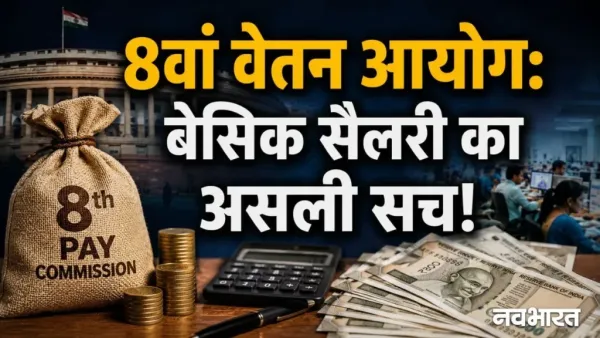
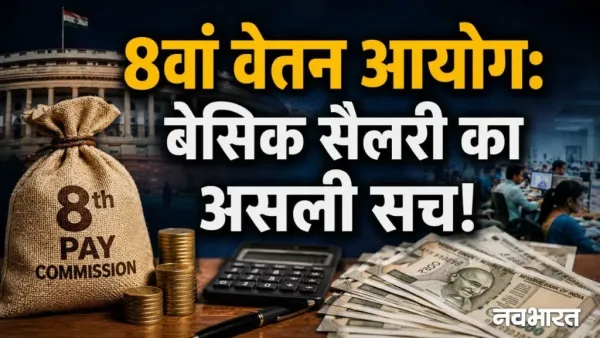
8th Pay Commission Latest Update: The discussion regarding the Eighth Pay Commission is at its peak, because a decision on it is likely to be taken soon. The biggest discussion is based on the claim that the minimum basic salary of central government employees may increase from Rs 18,000 to around Rs 69,000. For about 1.2 crore central employees and pensioners (about 50 lakh working employees and about 70 lakh pensioners), there is hope that something big can be announced for them in the new pay commission. But is such an increase really possible? The answer to this is only ‘yes or no’ is much more difficult than.
This figure of minimum basic salary has emerged from a special demand of employee unions. This is not an official proposal of the Eighth Pay Commission, nor has the government given any indication that it is ready to accept it. Experts say that the final recommendation will probably be made more thoughtfully, in which a balance will be struck between the expectations of the employees and the financial capacity of the government.
Why the discussion of increasing basic salary to ₹69,000?
At the center of this debate is a number – the fitment factor. It is a multiplier which is used to change the existing basic salary of the employee when the new pay commission comes into effect. This forms the basis on which salary, pension and many allowances are recalculated. Under the Seventh Pay Commission, the fitment factor was fixed at 2.57, increasing the minimum basic salary from Rs 7,000 under the Sixth Pay Commission to Rs 18,000 with effect from January 2016.
This time, National Council-Joint Consultative Machinery (NC-JCM), which represents central government employees, has demanded a fitment factor of 3.83. If this is accepted, the minimum basic pay may increase to Rs 69,000. However, this is just a side issue.
Why do experts not expect an increase?
Most analysts believe that a fitment factor close to 3.83 will impose a huge financial burden on the Center and, ultimately, on many state governments, which often change their pay structures after the Centre. Instead, many experts expect the fitment factor to settle somewhere between 2.0 and 2.1, while others think it could be closer to the current level of 2.57 if financial conditions remain healthy. But, the fitment factor of 1.83 will also give a good increase in salary and pension. However, it will not be anywhere near the figure of Rs 69,000. If we understand in simple language, Rs 69,000 is the maximum demand that is being discussed.
Much more than basic salary
Many employees focus only on the revised basic salary. But the pay commission decides much more than this. House Rent Allowance (HRA), Transport Allowance (TA), pension, gratuity and various retirement benefits are all linked to the revised basic pay. Any increase in basic automatically impacts these components as well. Therefore, the final take-home salary may increase significantly even if the fitment factor remains lower than the demand of employee unions.
Impact on HRA more than basic pay
One of the most important proposals of the Commission is to the method of calculating HRA. Experts say the current framework does not properly reflect modern family structures or rising urban living costs. HRA approach, transport allowance and recognition of large families can increase the total salary of a Level-1 employee by up to 65 per cent, even if the highest fitment factor is not demanded.
Pay matrix of 7th Pay Commission may remain
Another important thing that is being discussed is whether the government should continue with the existing pay matrix introduced by the 7th Pay Commission. The pay matrix replaced the old grade pay system and made it easier to increase salaries in different government services. Many experts believe that this framework is working well to a large extent and can be retained with some changes rather than changing it completely. Instead of redesigning the structure from scratch, the 8th Pay Commission can focus on changing the pay levels, allowances and increases within the existing matrix.
How does the commission decide the salary of employees?
Contrary to popular belief, the Commission does not simply announce new salaries. It first seeks opinion from ministries, departments, employee unions, pensioners’ organizations and experts on the subject. Before preparing its recommendations for the government, the Commission is holding meetings in different cities and taking suggestions from the employees and their organizations.
When will the 8th Pay Commission be implemented?
eighth pay commission It was notified in January 2025 and was initially expected to come into effect from January 1, 2026, but it is unlikely to come into effect immediately. Previous pay commissions generally took two to three years to submit their reports before government approval and rollout. This means that employees may have to wait longer before seeing the revised salary in their pay slips. If it is implemented retrospectively, eligible employees may get arrears for the intervening time.
Contact to : xlf550402@gmail.com
Copyright © boyuanhulian 2020 - 2023. All Right Reserved.