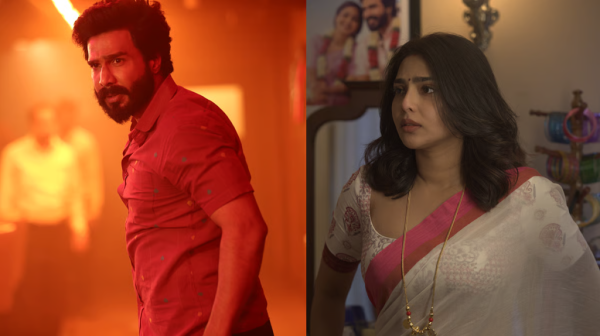
Gatta Kusthi 2 starts six years after the happenings of the first film. The baby that was born in the end of the first film is now six-year-old Mathi (Zara). Keerthy (Aishwarya Lekshmi) has a government job and is winning wrestling tournaments left, right, and center. Veera (Vishnuu Vishal) is a proud house husband, and just like a particular television brand, he is the Owner’s pride and the neighbour’s envy. Chella sets the tone of the film by having Veera play a 2026 version of Gopala Gopala’s Pandiarajan, who has the women in his apartment treat him as their confidante, much to the chagrin of their husbands. He dances with them, struggles with them for a place in the line to fill water in plastic pots, cooks special dishes and teaches them how to do so, and you get the drift, right? He is the ‘ideal’ man, but the film wastes no time in spelling out how this idealism is exalted only in the houses of others. It succinctly points out that society still looks down on men who take up the role of a homemaker. Even as it advocates respect for such choices, Gatta Kusthi 2 also asserts that this outlook persists because society has never accorded housewives the respect they deserve. “You insult househusbands only because you have never respected the hardwork of housewives,” says Veera in a scene. Even when exalting the men, Gatta Kusthi 2 doesn’t forget to tick the basics. That is why it is even more disappointing when it frequently resorts to plucking low-hanging fruit in building conflicts and employing reductive humour.
One might think having a misogynist uncle (Karunaas), who spews hate against independent women, and insults them in every scene, is the most problematic aspect of the film. However, the writing balances it out by painting him as the clear villain, who doesn’t understand that the world has evolved, and isn’t waiting for him to play catch-up. You have Veera who says all the right things, and does all the right things, except in one scene where he reverts to his slap-happy demeanour. While the film tries to justify it by adding layers of remorse, guilt, and more, one can’t help but be wary about how ‘inadvertent’ physical abuse is always glossed over in this franchise. Even when Keerthy cries after being slapped by Veera, and the family rightfully rallies around her, one character says, “Keerthy is crying because she hit her daughter, and not because she was hit by Veera.” That, how do you know? In fact, throughout the film, Keerthy is portrayed as hot-headed, nothing more. There is very little nuance to her character, and it is disappointing that the film doesn’t give her a chance to actually say what she feels. Imagine a film where a character is constantly pressurised, and yet, she is the one who has to ‘understand’ everything. It is a shame that, after a while, Keerthy is painted as just the nagging wife, who doesn’t know better. On the other end, it isn’t like Veera is any better. He does everything only to pull off an ‘I didn’t know better’ reaction. But Chella also paints an important picture as to how stinging words can be as painful as a slap. Apart from a song in the first few minutes, we hardly see Keerthy respond warmly to Veera. There are a lot of acerbic words being thrown around, and she doesn’t realise the impact it has on someone who understands his role in the family but wishes for more acknowledgment. These scenes are actually well-written, and they show that the battle of the sexes is not mostly about who wins, but about how no one loses in the end.
Contact to : xlf550402@gmail.com
Copyright © boyuanhulian 2020 - 2023. All Right Reserved.