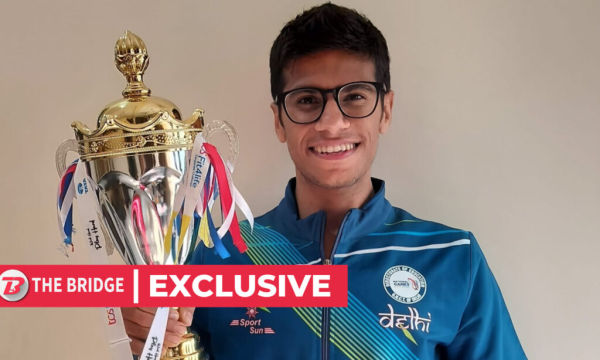
Jalaj Arora has represented India at national and international triathlon events, including the Asian Triathlon Cup in Nepal and Ironman 70.3 Goa. He has now qualified to compete for India at the Asian Triathlon Championship in Jordan.
But ahead of another international assignment, the Indian triathlete has found himself raising a familiar question: who pays for an athlete’s journey to represent the country?
Arora recently took to Instagram to highlight what he described as a lack of support from authorities. His videos drew attention to the financial burden he says athletes face while trying to compete at the international level.
“I have been doing this for the last eight years. You have to put a lot of money from your own pocket. I can pay from my own pocket, but until when will I keep doing that?” Jalaj told Read in an exclusive interview.
Funding his own journey
Jalaj says he has largely financed his sporting career himself.
His first opportunity to represent India at the Asian level came in 2022, when he competed at the Asian Triathlon Cup in Nepal after finishing fourth at the 2021 National Championships.
According to Arora, the government, the Indian federation and the Delhi federation did not fund that trip. His university covered his registration fee, flight and travel expenses, while he paid for his food.
“I only had to take care of my food expenses. So, at that time, there was someone to support me, but it was not the government, the Indian federation or the Delhi federation,” he said.
The experience has stayed with him as he prepares for another international competition.
“And this is the same thing that is happening now. This is why I raised my voice. At that time, I was able to manage it, and even now I can pay from my own pocket, but until when will I keep doing that?” he said.
What happened after his Instagram reel ?
Jalaj’s decision to speak publicly has brought greater attention to his situation. He says his videos have been widely reposted and that brands, sports organisations and other groups have subsequently approached him.
“Many brands are approaching me. Sports organisations and other groups are also approaching me and asking me to share a proposal and all the details so that they can see what they can do,” he said.
However, he says the response from the government has not yet changed.
“Until the support is actually provided and there is something officially on paper, I still want to raise the issue. I’m not going to stop,” he said.
Arora says his intention is also to highlight the difficulties faced by other athletes who are trying to balance high-performance sport with education or employment.
“It is about all the athletes who are training under difficult circumstances. Sports are really tough. It’s not easy, especially when you are trying to manage it alongside your education or your job,” he said.
The cost of competing in triathlon
For triathletes, the financial burden extends beyond entry fees and international travel.
Jalaj says equipment alone can require a significant investment, with a competition-level bicycle costing ₹5-6 lakh.
“Your bicycle itself can cost around ₹5-6 lakh very easily. Everyone who competes at that level is using technical equipment, and the more advanced your bicycle is, the more advantage you can get,” he said.
He estimates his monthly training expenses at ₹30,000-40,000, while international travel can add another ₹1 lakh.
“So, to participate in this sport, you need at least ₹1 lakh in hand as a minimum,” he said.
The cost also has a direct impact on his ability to compete regularly and accumulate ranking points.
“If I don’t pay from my own pocket to go and represent Delhi at these national championships, I won’t be able to earn those points. If I don’t get those points, I won’t be able to get a podium finish or qualify at the next level,” he said.
Lack of awareness remains a problem
Jalaj believes one of the biggest challenges facing Indian triathletes is the sport’s limited visibility.
“Basically, triathlon has very little awareness in India, whereas in other countries there is much more awareness of the sport,” he said.
That lack of visibility, he believes, makes it harder for athletes to attract sponsors and build wider public recognition.
“People will only know about the athletes if they see them. That’s why I had to come onto Instagram and raise my voice,” Arora said.
He points to Pune as an example of how greater awareness and private-sector involvement can create opportunities for athletes.
“In Pune, there are a lot of athletes who are getting funded. There are companies which have hired athletes and are giving them a stipend. They are taking care of their expenses, training equipment, travelling and everything,” he said.
Jalaj is now preparing for the Asian Triathlon Championship in Jordan, with another international competition ahead and the same financial questions still unresolved.
For now, he says he remains prepared to fund his own participation if necessary, but wants greater institutional support for athletes representing India.
Contact to : xlf550402@gmail.com
Copyright © boyuanhulian 2020 - 2023. All Right Reserved.