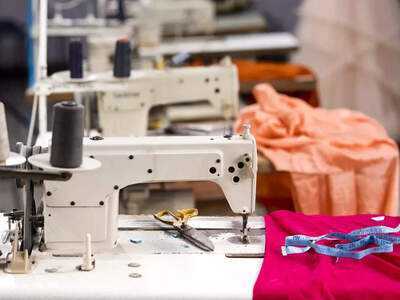
Mumbai: The uniform is no longer just for the factory floor. It now rides through traffic, shows up at customers' homes and is part of everyday work. It has become a moving billboard for brands.
India's B2B apparel market has more-than-doubled in five years to $2.1 billion, according to a CMAI-1Lattice report shared exclusively with ET.
Read more:
"On one hand, more and more Indian businesses are trying to look smarter. On the other, manufacturing units are becoming more safety conscious, leading to more controlled and safe clothing. Also, a business today wants to present a 'brand' image, which a smart uniform helps project. All these factors are pushing up sales in B2B sector," said Santosh Katariya, president of .
B2B apparel includes uniforms and workwear bought by companies, institutions and government agencies. The market covers everything from defence and healthcare to factories, hotels, retailers, security firms and transport companies. Industrial and manufacturing sectors remain the biggest segment at an estimated ₹4,800 crore, followed by hospitality at ₹2,900 crore and internal security at ₹2,200 crore. Defence and paramilitary forces account for ₹1,755 crore, while private security guards account for ₹1,050 crore. But a newer source of demand is emerging from India's gig economy. Delivery workers, home-service professionals and ride-hailing drivers are increasingly becoming the face of companies on the street. As gig work expands, so does the need for shirts, jackets and other workwear that can identify workers and the companies they represent.
Also Read: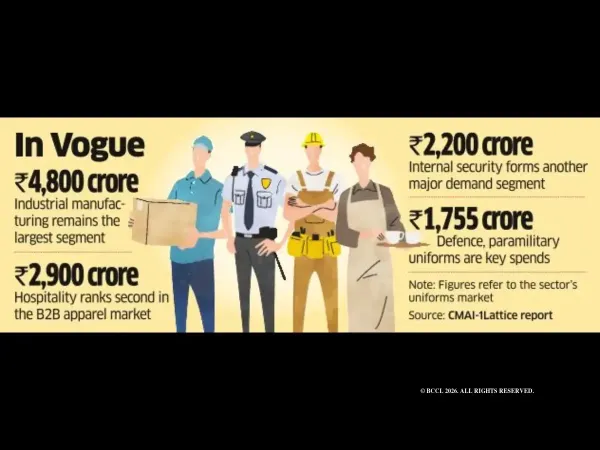
India had more than 6 million active monthly gig workers across delivery, ride-hailing and home services in 2025, according to Redseer. That number could rise to 17-21 million by 2030.
"While uniforms give employees a sense of identity and security, for consumers, they provide a simple assurance of who the worker represents and someone in whom they can place their confidence," said Garima, vice-president, supply chain, Flipkart.
Delivery is already the largest of the three gig segments, with about 2.4 million workers in 2025, according to Redseer. Home services had about 100,000 workers. The workforce spans food delivery, quick commerce, ecommerce logistics, appliance repair, plumbing, electrical work, cleaning and other services. The uniform market is still a small slice of India's overall apparel industry, which was worth $95.7 billion in 2025. But the broader industry has grown sharply from $68.5 billion in 2019 and is projected to reach $146 billion by 2029, implying annual growth of about 9%, the report said.
Contact to : xlf550402@gmail.com
Copyright © boyuanhulian 2020 - 2023. All Right Reserved.