Mumbai: India's benchmark is headed toward levels last seen during the 2022-23 tightening cycle, with traders warning that elevated crude oil prices, persistent debt supply, tight banking-system liquidity and expectations of further could push yields to 7.75% by December. The benchmark 10-year yield settled at 7.47% on Friday, its highest level since March 2023.
The yield has surged 78 basis points over the past four months, almost nearing the 7.61% peak touched during the previous rate-hike cycle.
Bankers said the selloff is being driven by a combination of external and domestic factors, with crude oil emerging as the biggest risk for bond investors. (FPI) have sold ₹20,772 crore from Indian debt so far this fiscal year, data showed. "The rate differential between India and the US justifies higher yields. At a time when the market is struggling with heavy bond supply, liquidity is getting drained and crude oil prices are moving higher, I expect the 10-year yield to touch 7.75% by December," said Rajeev Pawar, head of treasury, . 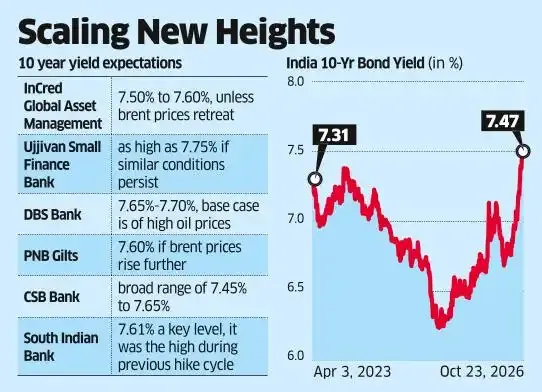 rose to $116.72 a barrel, their highest level since April, according to Reuters data. The sharp rise has raised concerns over inflation and the current account deficit as India imports bulk of its crude oil requirements.
Read more:
Treasury dealers said the market's earlier assumption that disruptions from the US-Iran conflict would be temporary has now given way to fears that elevated oil prices could persist through year-end, keeping alive and delaying any meaningful decline in bond yields.
Read more:
"There seems to be little respite for bond yields unless crude prices cool. This is not just a local story. It is an oil and treasury shock spreading across emerging markets," said Tanuj Khosla, MD at InCred Global Asset Management.
“Unless Brent retreats meaningfully from current levels, the benchmark yield could test 7.50%-7.60% before year-end.”
Paper Supply
Apart from oil, traders pointed to sustained government borrowing and tight liquidity conditions to impact yields. The Reserve bank of India (RBI) cancelled a Rs 23,000 crore treasury bill auction last week, as yield bids were likely higher than the central bank’s comfort. Short term rates have spiked up amid tight liquidity conditions.
“Our base case now assumes the geopolitical conflict persists, keeping crude oil prices elevated. Under this scenario, yields could rise to around 7.70% by December as inflationary and fiscal concerns intensify,” said Sameer Karyatt, head of trading at DBS Bank India.
Karyatt said the market reaction has become more pronounced because crude prices have moved well above $100 a barrel, a level beyond which investors begin to worry about broader inflation pass-through and second-round effects on the economy.
Not all market participants expect yields to rise relentlessly. Some traders believe a diplomatic breakthrough could stabilise oil prices and prevent a further sharp selloff in bonds.
“I am hoping some resolution emerges in the coming weeks. I am not expecting a rally, but yields could trade in a 7.45%-7.65% range if oil prices stabilise,” said Alok Singh, head of treasury at .
Even so, traders said the immediate focus will be on whether the benchmark yield breaches the 7.61% high recorded during the 2023 rate-hike cycle. A sustained move above that level could open the door to 7.70%-7.75%, especially if crude oil remains above $100 a barrel and liquidity conditions fail to improve.
Contact to : xlf550402@gmail.com
Copyright © boyuanhulian 2020 - 2023. All Right Reserved.