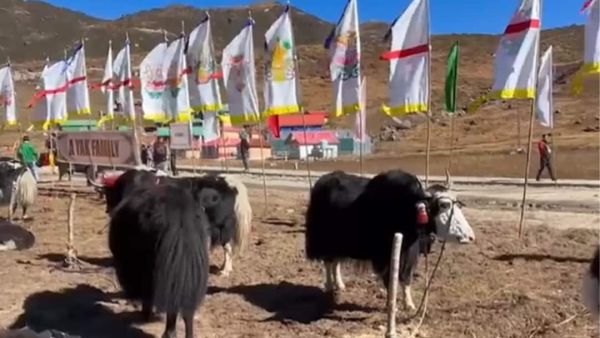
Sikkim has launched its first-ever Himalayan Yak Festival in Gnathang Valley, close to the India-China border, to draw attention to yak conservation and the livelihoods of communities that depend on the animal. Organised by the state’s Animal Husbandry and Veterinary Services Department, the event began on October 28 and brings together herders, officials and visitors. It also seeks to promote tourism in high-altitude areas and make yak rearing more sustainable. With hundreds of yaks and stalls showcasing yak products and breeding developments, the festival highlights concerns over declining yak numbers and the need to encourage younger generations to continue this occupation.
Himalayan Yak Festival Brings Herders Together
The festival was organised in Gnathang Valley despite challenging weather conditions in the high-altitude border region. Gnathang-Machong MLA Pamin Lepcha said preparations had been underway for a week, with around 400 to 500 yaks present at the event. Stalls displayed yak-based products and developments in artificial insemination for yak breeding.
Speaking to reporters, Lepcha said the gathering was intended to connect herders, raise awareness about their concerns and encourage government support.
“Since this is a high-altitude border area, the climatic conditions are very harsh. Today, about 400 to 500 yaks are present here, alongside a number of stalls showcasing yak products and artificial insemination (AI) breeding advancements. This event aims to bring the yak pastoral community together, raise public awareness, and ensure government support for herders,” he said.
Lepcha said the response to the inaugural festival had been encouraging and expressed hope that Gnathang would host it every year.
Yak Conservation And Youth Participation
Thupden Lachungpa, an executive member of the Yak Federation of India, said the festival could encourage younger people to return to yak herding. He told ANI that many had moved away from the occupation because it offered limited financial returns.
Speaking to ANI, Lachungpa said, “…Many of our youngsters were drifting away from the yak-rearing community; they were reluctant to engage in it because it was not profitable… This initiative helps us encourage our youth to return to yak herding.”
#WATCH | Gnathang Valley, Sikkim: The first-ever 'Sikkim Himalayan Yak Festival' kicked off in the high-altitude Gnathang Valley near the India-China border. Organised by the State's Animal Husbandry & Veterinary Services Department, the event aims to highlight yak conservation, boost high-altitude tourism, and promote sustainable livelihoods for pastoral communities in vibrant border villages. (28.10)
— ANI (@ANI) October 29, 2026
He added that the event had brought together people from different states, allowing them to exchange knowledge about yak rearing, local cultures and traditional ways of life. Lachungpa also highlighted the value of cooperation between states in responding to disease outbreaks among yaks.
He raised concerns about the declining yak population across the Himalayan region, particularly in Sikkim near the Chinese border. In his view, government measures such as purchasing yak-based products and offering incentives to herders could help protect the animals while making the occupation more viable.
‘Himalayan Pole’ Proposal Seeks To Protect Yak Identity
Lachungpa also proposed establishing a ‘Himalayan Pole’, which he referred to as the ‘Yak Pole’, to recognise the yak’s importance to the region and strengthen efforts to protect it.
“Currently, the world is viewed through two poles, the North Pole and the South Pole. We propose to establish a third pole: the ‘Himalayan Pole,’ which we could also call the ‘Yak Pole.’ The goal is to safeguard our unique identity, the Yak, which is native to the Himalayas and not found anywhere else. If we don’t take this step now, it might soon be too late, and someone else could lay claim to what is rightfully ours…” he said.
The first Himalayan Yak Festival comes as herders and officials look for ways to address the declining yak population, support border communities and preserve traditional livelihoods. Its organisers hope the event will help sustain yak rearing and encourage more young people to take up the practice.
Contact to : xlf550402@gmail.com
Copyright © boyuanhulian 2020 - 2023. All Right Reserved.