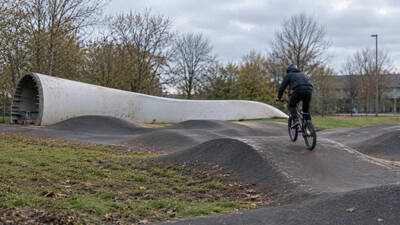
The catch-22 with wind energy is that it's almost irreplaceable because it's renewable. But the flip side is that wind turbine blades are made of composite materials that are difficult to recycle. They must, in turn, be either buried or burned. To counter this, researchers turned to a strategy which they called ‘ structural reuse ’ that whittles down hard-to-recycle and reuse materials. In this context, fibre-reinforced polymers are found in turbine blades. At , a student named Jesse Pupping , supervised by Jelle Joustra, an assistant professor, researched composite reuse. The reported in January 2025 that discarded blades were used to make rollers for a bike pump track . Earlier work focused on flat blade panels, so Joustra wanted to see if curved sections could work too.
Bridging the gap between code and curvature
Prior to this, researchers had mostly reused beams and joints to build trusses or make panels for furniture. Jesse Pupping’s research paper, written with colleagues and titled ‘,’ they undertook a task not yet touched upon: repurposing curved surfaces to create entirely new surfaces. But moulding curved components brought up the problem of design and modelling. The challenge was to figure out what shape and how to manufacture them from reclaimed parts.
This was addressed through a methodology they came up with that bridged industrial design and digital modelling. Researchers made a prototype to map out the constraints of the design process and, based on it, built a computer design tool. Their case study centred on pump tracks, which are bike tracks with contours and turns. They were designed to function based solely on the rider’s body momentum. These tracks had geometric properties akin to the complex curvature of wind turbine blades. This makes them more suitable for reuse and easier to design.
How to slice a giant wind turbine?
Researchers used the S-shaped contours of the blade panels and paired them together to replicate the sinusoidal shape of a roller. To test out their theory, they used a 30-meter, decommissioned turbine blade, the paper noted. In order to turn the twisted blades into a rideable track, they matched the curves of the blade to the one needed for the track. By using 1:20 paper cutouts of the blade’s cross-section, they determined what looked like track bumps. The blade was divided into small and large sizes. Because the blade naturally twists, it led to a 10 cm height misalignment. This was fixed by levelling the track with adjustable legs. The blade was cut by a CNC waterjet cutter, a machine that uses high-pressure water to cut through material. To prevent any bumps on the surface, the edges were cut at an inward angle to ensure the pieces fit. 4 modules were cut: 2 large and 2 small and they turned out to be lighter than the standard pump track pieces.  Smooth sailing or a rough ride?
The recycled blade was then connected to the pump track on the university campus. About 50 people participated in riding the track, according to the paper. Under repeated loading, the modules showed no sign of deformation, delamination or surface degradation. The blade pieces held up perfectly well, the track supplier said. The event concluded on a high note, with reviews garnering a strong 4.2 out of 5. The positive ones pointed to the track’s safety, sturdiness and strong grip. The negative reviews described the track as jumpy, stiff and steep. The researchers realised this happened because they set the bumps up slightly too high for the event.
Unexpected quirks and future possibilities
Researchers discovered a twist in the feature; instead of eliminating the blade’s natural twist, they suggested using it on purpose to add bank corners and wavy tracks. Another eureka moment arrived when they tested the same cutting method on a 60-meter blade, twice the size of the prototype they used, and realised it worked on bigger blades too. There were, however, some limitations to be considered. Cutting the blade straight would create an angled edge because of its thickness. And if the pieces are arranged incorrectly, it leaves a V-shaped gap on the riding surface.
Besides its drawbacks, researchers remained bullish about the future uses of retired blades. By using computer algorithms to scan a blade, a perfect custom track would be easier to create with less leftover waste material. In public structures, curved structures like bus shelters could be made out of connected blade panels. They also pointed to the different ways curved panels can be used in architecture. These included roof structures, wavy wall cladding and acoustic ceiling panels for transit hubs and large buildings. The same recycling algorithm could also be used on retired aeroplanes and boats to recover aluminium and composite parts instead of sending them to landfills.
Contact to : xlf550402@gmail.com
Copyright © boyuanhulian 2020 - 2023. All Right Reserved.