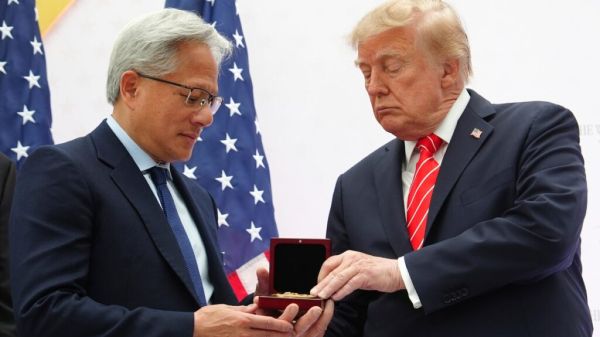
Washington: US President Donald Trump on Monday welcomed Nvidia’s decision to reinstate Jensen Huang as its president and CEO, describing the move as the “correct and proper decision”.
Nvidia’s board of directors voted unanimously to bring back Huang with immediate effect, reversing its earlier position that it did not intend to reinstate him. The decision follows weeks of turmoil at the artificial intelligence chipmaker after Huang resigned amid reports of an extramarital relationship with Alice Huang, a Chinese businesswoman suspected by US intelligence agencies of having links to China’s intelligence services. The two are not .
In a statement, Nvidia board chair Harvey C Jones said the directors believed Huang was the right person to lead the company and that his return was in the interests of its shareholders, employees, partners and customers.
Huang said he was “honored” to return and would take up the responsibility with “the greatest humility and renewed commitment”. He thanked the board, interim CEO Colette Kress, the company’s executive team, employees, shareholders and business partners for their support.
Kress, who had taken over as interim CEO following Huang’s departure, will return to her position as chief financial officer.
Why did Jensen Huang leave Nvidia?
Huang, who co-founded Nvidia in 1993, resigned as CEO on November 11 amid controversy over his reported relationship with Alice Huang, a former executive at Singapore-based technology company Megaspeed International.
Reports citing US intelligence assessments alleged that Alice Huang had been recruited by China’s Ministry of State Security and had developed a relationship with the Nvidia chief as part of an intelligence effort. Huang acknowledged having an affair and apologized to his family and the company’s employees.
Nvidia’s board had launched an independent investigation into reports that its chief executive had been targeted by a foreign intelligence operation. Colette Kress was appointed interim CEO after the board accepted Huang’s resignation.
Huang subsequently indicated that he was willing to return. However, on November 17, board chair Harvey Jones said Nvidia did not intend to reinstate him, despite public support for his comeback from Trump and several technology industry figures.
What changed before the board reversed its decision?
Nvidia said its board held a pseries of discussions and meetings with Huang before reaching its latest decision. It said directors were satisfied with his candour and his ability to lead the company.
The company also disclosed that the board had received input from senior levels of the US government. Based on that input, it said, the directors were confident that Huang’s reinstatement did not pose a national security risk.
Trump had publicly expressed support for Huang’s return in the days before the decision. On November 16, he said he would not mind seeing the Nvidia chief reinstated and suggested that Huang had learned a lesson. His latest endorsement came after the board announced its unanimous decision.
However, Nvidia’s statement does not establish that Trump’s intervention determined the outcome. The company cited its discussions with Huang and input from senior US government officials as part of the board’s decision-making process.
Investigation into alleged Chinese intelligence links to continue
Huang’s reinstatement does not bring the controversy to an end. Nvidia said the independent committee formed to investigate reports of a foreign intelligence effort would continue its work. The committee comprises independent directors and has retained external legal counsel.
The company has also established a separate National Security and Export Control Committee to oversee trade compliance and national security risks. It is appointing a chief compliance officer and said it would continue cooperating with ongoing government investigations and inquiries.
The allegations involving Alice Huang have not been established as fact. Reuters reported on November 23 that US officials had not concluded that she had spied for China. US Attorney General Todd Blanche and Director of National Intelligence Jay Clayton have said the matter remains under investigation.
The controversy has also drawn attention to the enforcement of US restrictions on advanced AI chip exports to China. Megaspeed International, which Alice Huang previously led, has been under investigation by US authorities since 2024 over concerns that it may have smuggled advanced Nvidia chips to Chinese entities.
What Huang’s return means for Nvidia
Huang’s reinstatement restores the leadership of the company’s co-founder at a time when Nvidia remains central to the global artificial intelligence industry. His departure had raised questions about leadership continuity at the chipmaker, which supplies advanced processors used in AI development and data centers.
The board’s decision also comes with additional oversight measures. Its continued investigation, the creation of a National Security and Export Control Committee and the appointment of a chief compliance officer indicate that the company intends to address governance and national security concerns alongside Huang’s return.
The wider issue extends beyond Huang’s personal conduct. US authorities are examining possible intelligence links and concerns about the movement of advanced AI chips to China. The outcome of those investigations could have implications for Nvidia’s compliance obligations and the broader debate over semiconductor exports.
Trump’s public support for Huang formed part of the backdrop to the reinstatement, but the company’s announcement specifically cited government input and the board’s own discussions. The investigation into the alleged foreign intelligence operation remains open.